Bible lesson
Chapter 11: Abraham’s Close, Birthright, Blessing, and Beth-el
Study notes, questions and the Bible passages that Kingdoms of Scripture Chapter 11 covers, as the game’s chapter map shows them. Read the passages first in the Kingdoms of Scripture Bible, the text the game quotes: the game’s choices, maps and staging are reconstructions, not scripture. This page is not a church lesson and adds no doctrine.
Study notes
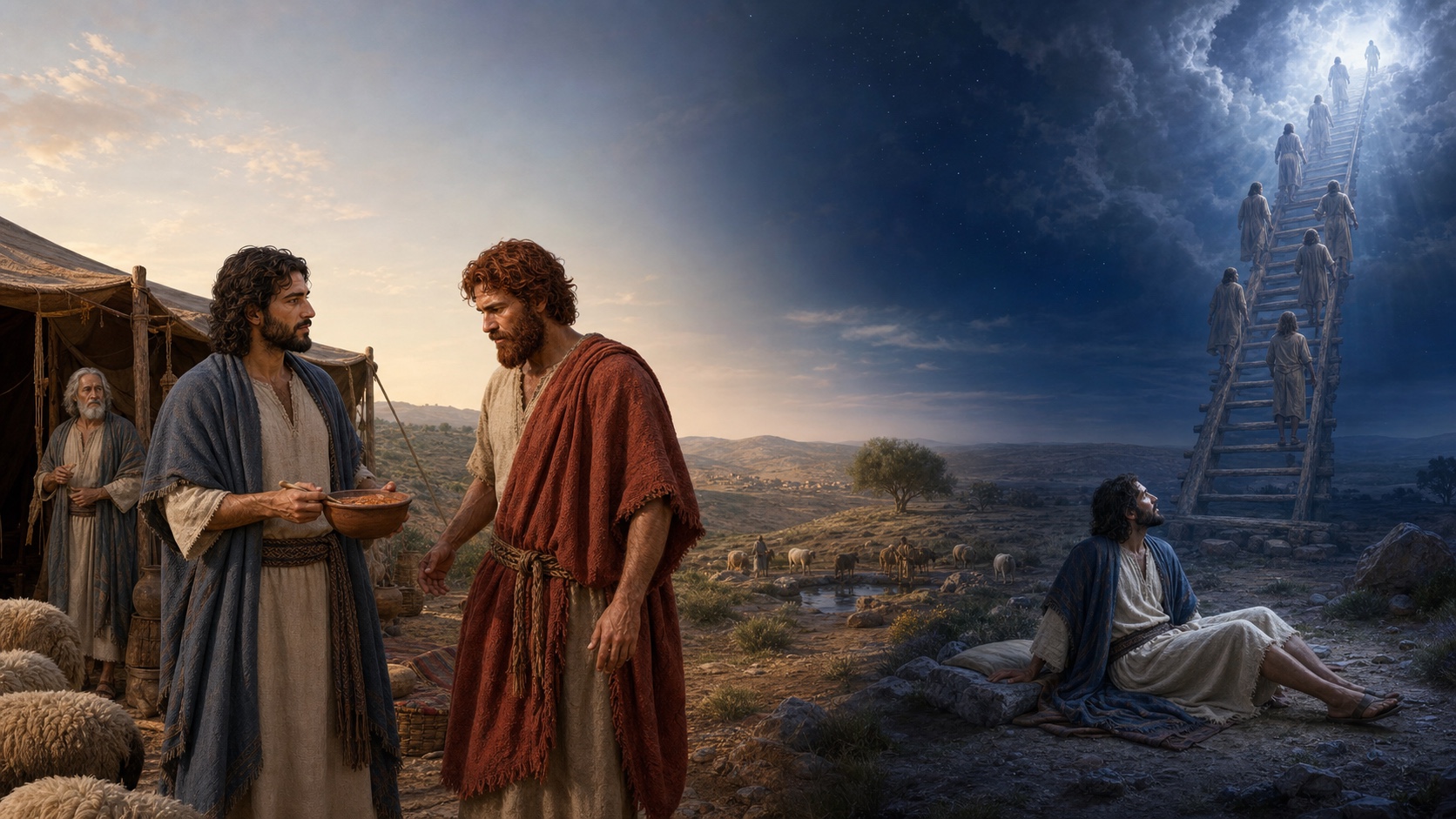
Abraham dies after a long life, and Esau trades his birthright to Jacob for bread and lentil stew. Later Jacob tells his father Isaac that he is Esau and receives his blessing, and on the way toward Haran he dreams of a stairway reaching the sky and hears Yahweh promise him the land.
From Genesis 25:7–8 (KoS), Genesis 25:29–34 (KoS), Genesis 27:18–24 (KoS), Genesis 28:10–17 (KoS).
These notes and questions are original study helps written for this site, not scripture. The verses shown with each question are quoted from the Kingdoms of Scripture Bible.
- Chapter
- 11
- Title
- Abraham’s Close, Birthright, Blessing, and Beth-el
- Bible passages
- Genesis 25:1–28:22
- Read in the Kingdoms of Scripture Bible
- The chapter opens with
Jacob woke from his sleep and said, “Surely Yahweh is in this place, and I did not know it.” He was afraid and said, “How awesome this place is. This is nothing other than the house of God, and this is the gate of the sky.”
Notice and discuss
Read each passage, then think about the question on your own or talk it over with others. No answers are collected.
-
What does Yahweh say to Rebekah when she goes to ask about the children struggling inside her?
The children crushed each other inside her, and she said, “If it is like this, why am I like this?” She went to inquire of Yahweh. Yahweh said to her, “Two nations are in your womb, and two peoples will be divided from your body. One people will be stronger than the other people, and the older will serve the younger.”
Note · Text Leningrad writes goyim with a yod where the Masoretic reading has a vav, goyim, “nations.” The word is the same. The written spelling is what the consonants show, and the English is “nations” either way.
-
What names does Isaac give the wells his servants dig, and what does he say about the last one?
Isaac went from there, camped in the wadi of Gerar, and settled there. Isaac dug again the wells of water that had been dug in the days of Abraham his father and that the Philistines had stopped up after Abraham’s death. He called them by the same names his father had called them. Isaac’s servants dug in the wadi and found there a well of fresh water. The herders of Gerar quarreled with Isaac’s herders, saying, “The water is ours.” He named the well Esek, because they contended with him. They dug another well, and they quarreled over that one too, so he named it Sitnah. He moved on from there and dug another well, and they did not quarrel over it. He named it Rehoboth and said, “Now Yahweh has made room for us, and we will be fruitful in the land.”
Note · Translation Esek sounds like the verb “they contended.”
Note · Translation Sitnah is “accusation,” the same family of words as an accuser.
Note · Translation Rehoboth means “wide places,” room to live.
-
What conditions does Jacob name in his vow, and what does he say he will do if they are met?
Jacob made a vow. He said, “If God will be with me and will guard me on this way that I am going, and will give me bread to eat and clothing to wear, and I return in peace to my father’s house, then Yahweh will be my God, and this stone that I have set up as a standing stone will be a house of God, and of all that you give me I will give a tenth back to you.”
Use your browser’s Print command to print or save a PDF.
Kingdoms of Scripture Bible (KoS). CC BY 4.0. Source: bible.kingdomsofscripture.com. Quotations are whole published verses, matched to the game’s chapter references.