Bible lesson
Chapter 37: Moses Rehearses the Covenant Journey
Study notes, questions and the Bible passages that Kingdoms of Scripture Chapter 37 covers, as the game’s chapter map shows them. Read the passages first in the Kingdoms of Scripture Bible, the text the game quotes: the game’s choices, maps and staging are reconstructions, not scripture. This page is not a church lesson and adds no doctrine.
Study notes
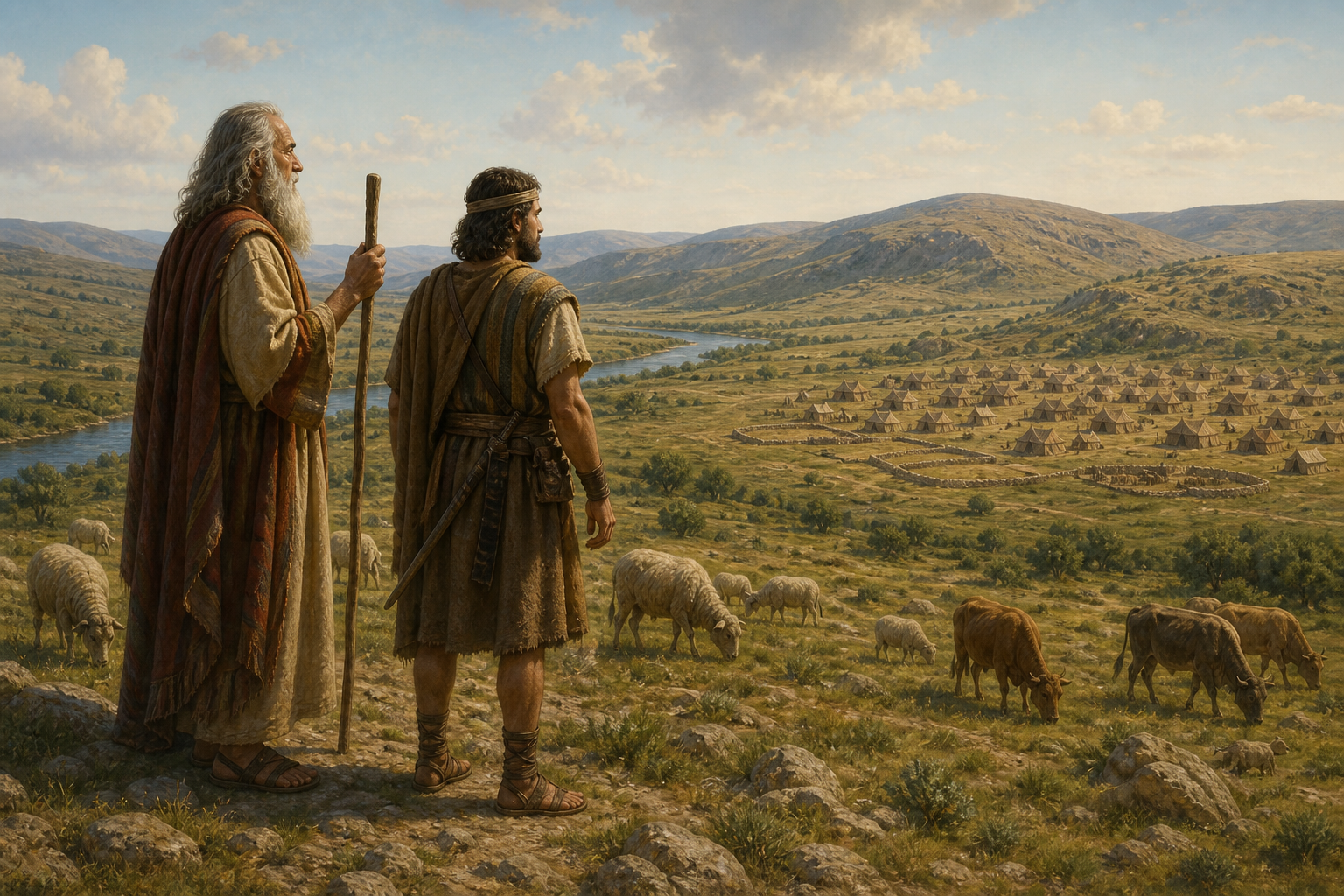
In Moab, after the defeat of Sihon and Og, Moses reminds Israel of the journey from Horeb and of the people’s refusal to go up. He recalls the ten words on stone tablets, how he broke the first tablets when he saw the cast calf, and how he later put new tablets in a wooden chest.
From Deuteronomy 1:1–8 (KoS), Deuteronomy 1:26–33 (KoS), Deuteronomy 9:15–21 (KoS), Deuteronomy 10:1–5 (KoS).
These notes and questions are original study helps written for this site, not scripture. The verses shown with each question are quoted from the Kingdoms of Scripture Bible.
- Chapter
- 37
- Title
- Moses Rehearses the Covenant Journey
- Bible passages
- Deuteronomy 1:1–4:43; Deuteronomy 5:1–5:33; Deuteronomy 9:1–10:11
- Read in the Kingdoms of Scripture Bible
- The chapter opens with
These are the words that Moses spoke to all Israel beyond the Jordan, in the wilderness, in the Arabah, opposite Suph, between Paran and Tophel, Laban, Hazeroth, and Di-zahab. It is eleven days from Horeb, by the way of Mount Seir, as far as Kadesh-barnea. In the fortieth year, in the eleventh month, on the first of the month, Moses spoke to the sons of Israel according to all that Yahweh had commanded him for them, after he had struck Sihon king of the Amorite, who lived in Heshbon, and Og king of Bashan, who lived in Ashtaroth, at Edrei. Beyond the Jordan, in the land of Moab, Moses undertook to make this instruction plain, saying, Yahweh our God spoke to us at Horeb, saying, You have stayed long enough at this mountain. Turn and set out, and come to the hill country of the Amorite and to all his neighbors, in the Arabah, in the hill country, in the Shephelah, in the Negev, and on the coast of the sea, the land of the Canaanite, and the Lebanon, as far as the great river, the river Euphrates. See, I have set the land before you. Go in and take possession of the land that Yahweh swore to your fathers, to Abraham, to Isaac, and to Jacob, to give to them and to their seed after them.
Note · Process No published English Bible, commentary, or study note was open while Deuteronomy was drafted. The wording source was the ancient-language witnesses named in the notes. A lexicon or grammar may be used for a source word. Greek, Syriac, and Latin, when they appear, witness the source wording. They are not models for the English.
Note · Text The continuous copy is the Leningrad Codex, read in the Open Scriptures diplomatic text of the Westminster Leningrad Codex. Dead Sea copies of Deuteronomy are fragmentary. This draft does not replace Leningrad with a reading that was not read off a fragment. No earlier wording is guessed into the English. The Samaritan Pentateuch and the Greek, Syriac, and Latin versions are witnesses, not the default. Written consonants are printed. Where the Masoretic reading differs, the note says so.
Note · Translation Suph is the place written here. It is not the Sea of Reeds. That name, yam suf, is in verse 40. Di-zahab is the place name as written.
Note · Translation Yahweh prints the divine name. The consonants in the Hebrew are YHWH. The vowels in “Yahweh” are a later convention, not a record of how the oldest copies said the name. See the glossary.
Note · Translation Torah is instruction, as in the ritual books. Ho’il be’er is he undertook to make it plain.
Note · Translation YHWH Elohim is printed Yahweh God. Yahweh is the name. God is Elohim. A suffix makes it “our God” or “your God.” See the glossary.
Notice and discuss
Read each passage, then think about the question on your own or talk it over with others. No answers are collected.
-
Whom does Yahweh say will still enter the land, and who does he say will not?
Yahweh heard the sound of your words, and he was angry, and he swore, saying, Not one of these men, this evil generation, shall see the good land that I swore to give to your fathers, except Caleb son of Jephunneh. He shall see it, and I will give the land he walked on to him and to his sons, because he followed fully after Yahweh. Yahweh was angry with me too, on your account, saying, You also shall not go in there. Joshua son of Nun, who stands before you, he shall go in there. Strengthen him, for he shall give Israel its inheritance. And your little ones, who you said would be taken as plunder, your children who today do not know good or evil, they shall go in there. I will give it to them, and they shall take possession of it. But you, turn and set out into the wilderness by the way of the Sea of Reeds.
Note · Translation The oath is an “if”: if a man of these men sees the land. The sense of that oath is that he will not see it. The “if” is not printed as an open condition.
Note · Translation Yam suf is the Sea of Reeds.
-
What do the tribal heads and elders ask Moses to do after the voice speaks from the fire, and why?
These words Yahweh spoke to your whole assembly on the mountain, from the midst of the fire, the cloud, and the thick gloom, a great voice, and he did not do it again. He wrote them on two tablets of stone and gave them to me. When you heard the voice from the midst of the darkness, and the mountain was burning with fire, you came near me, all the heads of your tribes and your elders. You said, Look, Yahweh our God has shown us his glory and his greatness, and we have heard his voice from the midst of the fire. This day we have seen that God speaks with a human, and he lives. Now, why should we die? For this great fire will eat us up. If we hear the voice of Yahweh our God any more, we will die. For who of all flesh has heard the voice of the living God speaking from the midst of the fire, as we have, and lived? You go near, and hear all that Yahweh our God says, and you, you shall speak to us all that Yahweh our God speaks to you, and we will listen and do it.
Note · Translation Velo yasaf is he did not do it again, the same idiom as in Numbers 11:25. It is not “he did not cease.”
-
What reasons does Moses give when he prays that Yahweh will not destroy the people?
At Taberah, at Massah, and at Graves of the Craving, you were provoking Yahweh. And when Yahweh sent you from Kadesh-barnea, saying, Go up and take possession of the land that I have given you, you rebelled against the mouth of Yahweh your God, and you did not trust him, and you did not listen to his voice. You have been rebellious against Yahweh from the day I knew you. I threw myself down before Yahweh those forty days and forty nights that I threw myself down, because Yahweh had said he would destroy you. I prayed to Yahweh and said, My Lord Yahweh, do not destroy your people and your inheritance, whom you redeemed in your greatness, whom you brought out of Egypt with a strong hand. Remember your servants, Abraham, Isaac, and Jacob. Do not look at the stubbornness of this people, or at their wickedness, or at their wrong. Or the land from which you brought us out will say, Because Yahweh was not able to bring them into the land he spoke of to them, and because he hated them, he brought them out to kill them in the wilderness. They are your people and your inheritance, whom you brought out by your great power and by your outstretched arm.
Note · Translation Graves of the Craving is the same place as in Numbers 11. The name is translated because that chapter gives its sense.
Note · Translation The consonants after “my Lord” are YHWH. The vowels on that name are the vowels of Elohim. The consonants are printed as Yahweh.
Use your browser’s Print command to print or save a PDF.
Kingdoms of Scripture Bible (KoS). CC BY 4.0. Source: bible.kingdomsofscripture.com. Quotations are whole published verses, matched to the game’s chapter references.