Bible lesson
Chapter 26: The Tabernacle, the Calf, and Covenant Renewal
Study notes, questions and the Bible passages that Kingdoms of Scripture Chapter 26 covers, as the game’s chapter map shows them. Read the passages first in the Kingdoms of Scripture Bible, the text the game quotes: the game’s choices, maps and staging are reconstructions, not scripture. This page is not a church lesson and adds no doctrine.
Study notes
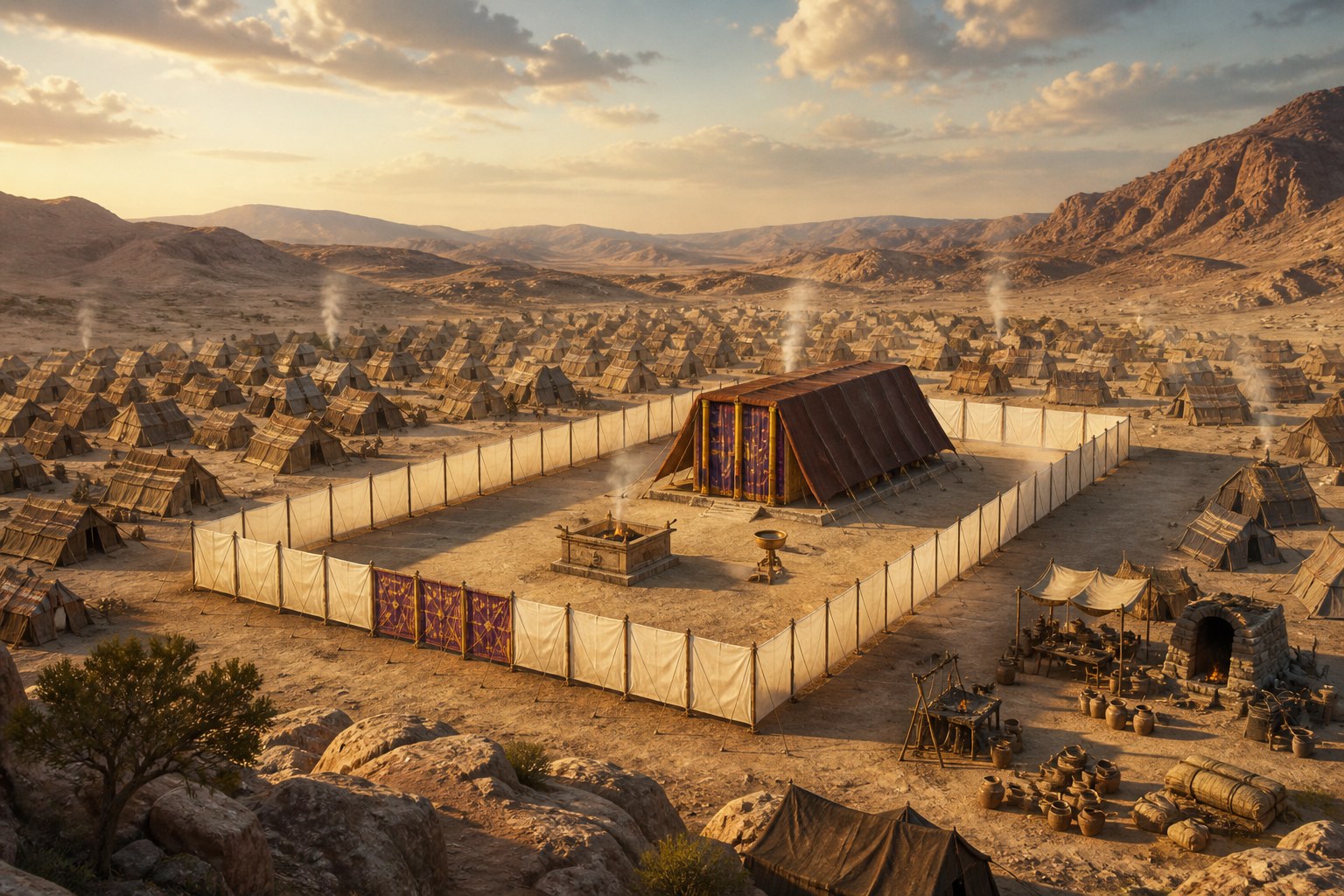
While Moses is slow to come back down, the people ask Aaron to make them gods, and when Moses sees the calf, he shatters the tablets. Yahweh has Moses cut two new stone tablets, and in the end the tent of meeting is covered by the cloud as Yahweh’s glory fills the dwelling.
From Exodus 32:1 (KoS), Exodus 32:19 (KoS), Exodus 34:1 (KoS), Exodus 40:34 (KoS).
These notes and questions are original study helps written for this site, not scripture. The verses shown with each question are quoted from the Kingdoms of Scripture Bible.
- Chapter
- 26
- Title
- The Tabernacle, the Calf, and Covenant Renewal
- Bible passages
- Exodus 25:1–40:38
- Read in the Kingdoms of Scripture Bible
- The chapter opens with
They shall make me a sanctuary, and I will dwell among them.
Note · Translation Miqdash is a holy place, a sanctuary. Shakhanti is “I will dwell.” The dwelling, mishkan, is named in the next verse.
Notice and discuss
Read each passage, then think about the question on your own or talk it over with others. No answers are collected.
-
What has Bezalel son of Uri been filled with, according to this passage?
“See, I have called by name Bezalel son of Uri, son of Hur, of the tribe of Judah. I have filled him with the spirit of God, with wisdom, with understanding, with knowledge, and with all kinds of work,
-
What does Moses tell Yahweh the people have done when he returns to him?
Moses returned to Yahweh and said, “Please, this people has done a great offense. They have made themselves gods of gold.
-
How does Yahweh describe himself as he passes by and calls out his name?
Yahweh came down in the cloud and stood with him there, and he called out the name Yahweh. Yahweh passed in front of him and called, “Yahweh, Yahweh, a God tender and gracious, slow to anger, great in loyalty and in what holds firm, keeping loyalty for thousands, carrying guilt, rebellion, and offense, and clearing, he does not clear, calling the guilt of fathers to account on children and on children’s children, on the thirds and on the fourths.”
Note · Translation Chesed is loyalty. Emet is what holds firm, truth that can be relied on. Both are printed. “Goodness and truth” is not.
Note · Translation The clearing line is an infinitive and a finite verb of the same root: clearing, he does not clear. No object is named. “The guilty” is not added. “For thousands” does not say generations.
Use your browser’s Print command to print or save a PDF.
Kingdoms of Scripture Bible (KoS). CC BY 4.0. Source: bible.kingdomsofscripture.com. Quotations are whole published verses, matched to the game’s chapter references.