Bible lesson
Chapter 28: Atonement Observed and the Camp Judged
Study notes, questions and the Bible passages that Kingdoms of Scripture Chapter 28 covers, as the game’s chapter map shows them. Read the passages first in the Kingdoms of Scripture Bible, the text the game quotes: the game’s choices, maps and staging are reconstructions, not scripture. This page is not a church lesson and adds no doctrine.
Study notes
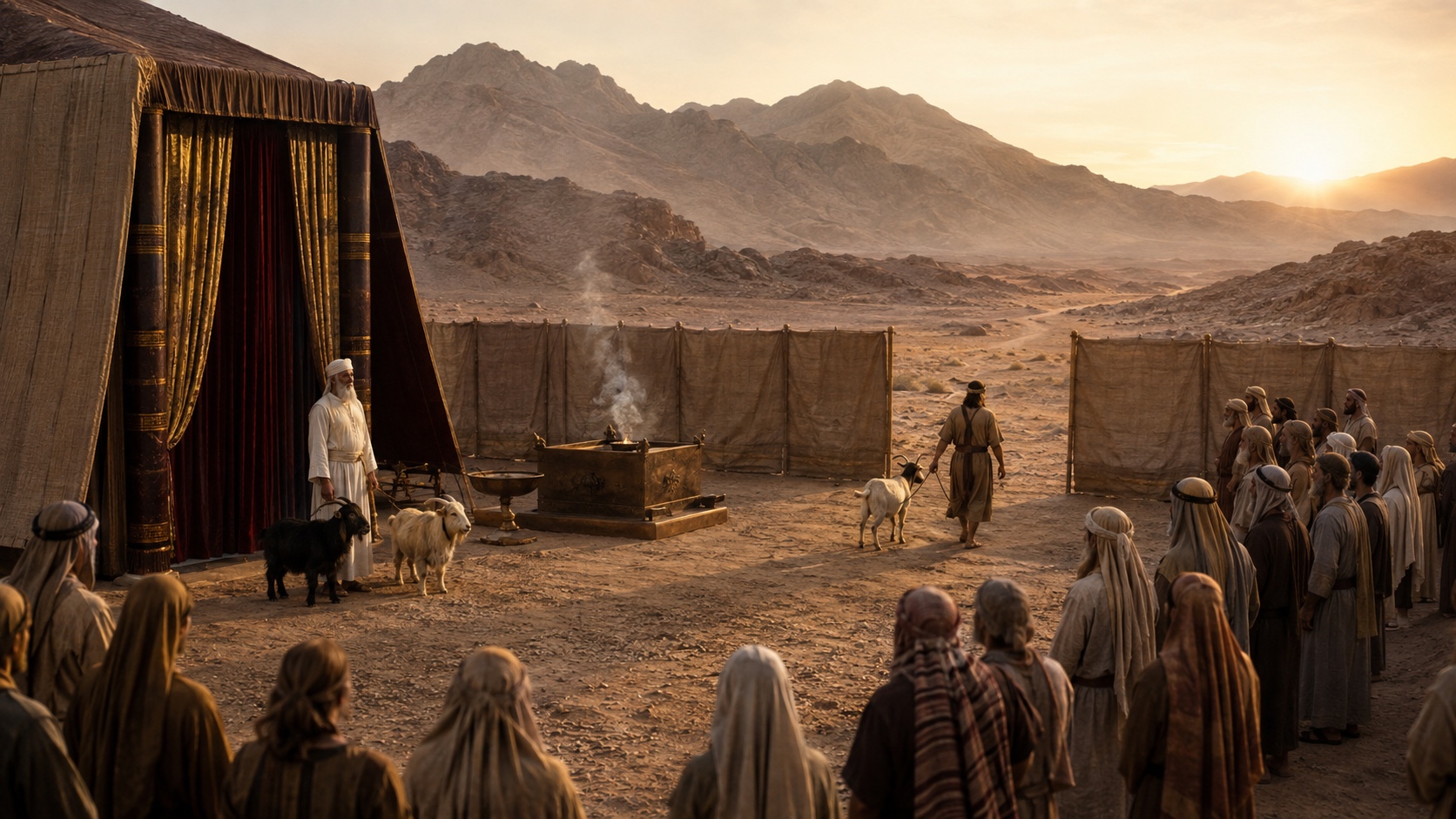
Yahweh sets a day in the seventh month, kept once a year with no work, when Aaron makes atonement and sends one of two goats alive into the wilderness to Azazel. An Israelite woman’s son fights in the camp and curses using the Name, and after Yahweh gives his ruling, the people stone him outside the camp.
From Leviticus 16:6–10 (KoS), Leviticus 16:29–34 (KoS), Leviticus 24:10–12 (KoS), Leviticus 24:23 (KoS).
These notes and questions are original study helps written for this site, not scripture. The verses shown with each question are quoted from the Kingdoms of Scripture Bible.
- Chapter
- 28
- Title
- Atonement Observed and the Camp Judged
- Bible passages
- Leviticus 16:1–16:34; Leviticus 24:10–24:23
- Read in the Kingdoms of Scripture Bible
- The chapter opens with
This shall be a lasting statute for you. In the seventh month, on the tenth of the month, you shall afflict your persons, and you shall do no work, the native and the sojourner who sojourns among you. For on this day he shall make atonement for you, to cleanse you. From all your offenses you shall be clean before Yahweh. It is a sabbath of complete rest for you, and you shall afflict your persons. It is a lasting statute. The priest who is anointed, and whose hand is filled to serve as priest in place of his father, shall make atonement. He shall wear the linen garments, the holy garments. He shall make atonement for the holy sanctuary, and he shall make atonement for the tent of meeting and for the altar, and he shall make atonement for the priests and for all the people of the assembly. This shall be a lasting statute for you, to make atonement for the sons of Israel from all their offenses once in the year. And he did as Yahweh commanded Moses.
Note · Translation Innah nafesh is to afflict the person. The day is the tenth of the seventh month. Kipper, atonement, is to cover, as earlier in this book.
Note · Translation Mille et yado is filling the hand, the installation of the priest, as milluim earlier in this book.
Notice and discuss
Read each passage, then think about the question on your own or talk it over with others. No answers are collected.
-
What clothing is Aaron to put on for entering the holy place, and what must he do first?
With this Aaron shall come into the holy place: with a bull, a son of the herd, for an offense offering, and a ram for a whole offering. He shall wear a holy linen tunic, and linen undergarments shall be on his body. He shall gird himself with a linen sash and wrap on a linen turban. They are holy garments. He shall wash his body in water and put them on. From the congregation of the sons of Israel he shall take two male goats of the goats for an offense offering, and one ram for a whole offering.
-
What does Aaron do with the living goat after he brings it near?
When he has finished making atonement for the holy place, the tent of meeting, and the altar, he shall bring near the living goat. Aaron shall lay the two of his hand on the head of the living goat and confess over it all the guilt of the sons of Israel and all their rebellions, for all their offenses. He shall put them on the head of the goat and send it by the hand of a man ready for the time into the wilderness. The goat shall carry on itself all their guilt to a cut-off land, and he shall send the goat into the wilderness.
Note · Text The written consonants are שתי ידו, “the two of his hand.” The Masoretic reading is ידיו, “his hands.” The written form is printed.
Note · Translation Ish itti is a man designated for that time, the one who leads the goat out.
Note · Translation Eretz gezerah is a land cut off, a land set apart from settlement.
-
What do the people do with the man after he curses, and what are they waiting to learn?
The son of an Israelite woman went out, and he was the son of an Egyptian man, among the sons of Israel. The son of the Israelite woman and an Israelite man fought in the camp. The son of the Israelite woman pronounced the Name and cursed. They brought him to Moses. His mother’s name was Shelomith, daughter of Dibri, of the tribe of Dan. They put him in custody, so that it would be made clear to them by Yahweh’s mouth.
Note · Translation Naqav et ha-shem is to pronounce the Name, to pierce it by speaking it in the curse. The Name is not written out in this verse. Verse 16 names Yahweh.
Use your browser’s Print command to print or save a PDF.
Kingdoms of Scripture Bible (KoS). CC BY 4.0. Source: bible.kingdomsofscripture.com. Quotations are whole published verses, matched to the game’s chapter references.