Bible lesson
Chapter 29: The Camp Ordered and Departing Sinai
Study notes, questions and the Bible passages that Kingdoms of Scripture Chapter 29 covers, as the game’s chapter map shows them. Read the passages first in the Kingdoms of Scripture Bible, the text the game quotes: the game’s choices, maps and staging are reconstructions, not scripture. This page is not a church lesson and adds no doctrine.
Study notes
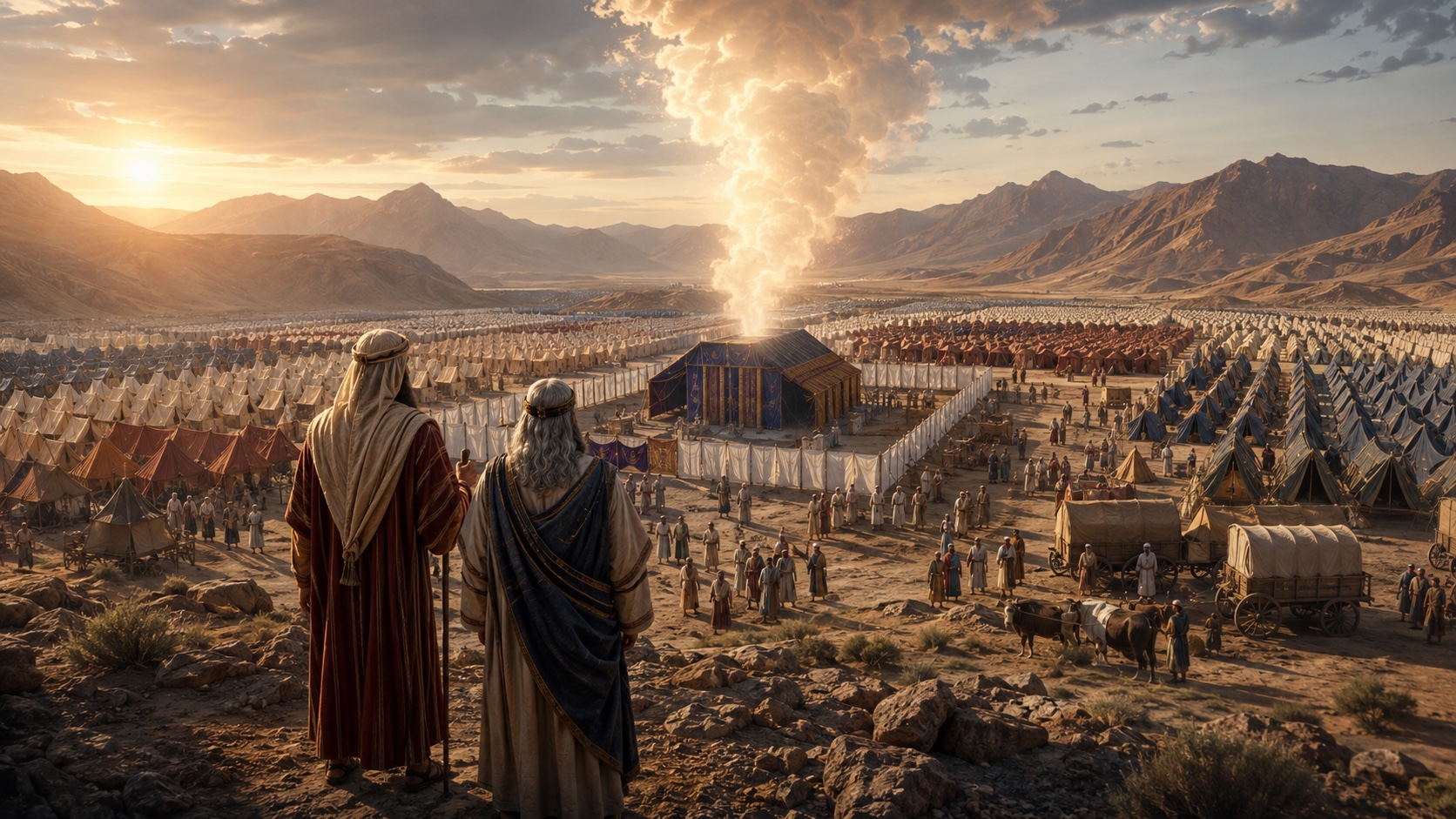
At Sinai, Moses and Aaron count Israel’s men twenty and older for the army, but the Levites are left out of the count to carry and guard the dwelling. After the dwelling is anointed and the chiefs bring gifts, the cloud lifts and the tribes set off from Sinai in order behind Yahweh’s covenant chest.
From Numbers 1:1–4 (KoS), Numbers 1:44–54 (KoS), Numbers 7:1–11 (KoS), Numbers 10:11–36 (KoS).
These notes and questions are original study helps written for this site, not scripture. The verses shown with each question are quoted from the Kingdoms of Scripture Bible.
- Chapter
- 29
- Title
- The Camp Ordered and Departing Sinai
- Bible passages
- Numbers 1:1–4:49; Numbers 7:1–10:36
- Read in the Kingdoms of Scripture Bible
- The chapter opens with
In the second year, in the second month, on the twentieth of the month, the cloud lifted from over the dwelling of the Testimony. The sons of Israel set out on their stages from the wilderness of Sinai, and the cloud settled in the wilderness of Paran. They set out for the first time at the mouth of Yahweh, by the hand of Moses. The banner of the camp of the sons of Judah set out first, by their armies, and over its army was Nahshon son of Amminadab. Over the army of the tribe of the sons of Issachar was Nethanel son of Zuar. Over the army of the tribe of the sons of Zebulun was Eliab son of Helon. The dwelling was taken down, and the sons of Gershon and the sons of Merari set out, carrying the dwelling. The banner of the camp of Reuben set out by their armies, and over its army was Elizur son of Shedeur. Over the army of the tribe of the sons of Simeon was Shelumiel son of Zurishaddai. Over the army of the tribe of the sons of Gad was Eliasaph son of Deuel. The Kohathites set out, carrying the sanctuary, and the others set up the dwelling before they arrived. The banner of the camp of the sons of Ephraim set out by their armies, and over its army was Elishama son of Ammihud. Over the army of the tribe of the sons of Manasseh was Gamaliel son of Pedahzur. Over the army of the tribe of the sons of Benjamin was Abidan son of Gideoni. The banner of the camp of the sons of Dan set out, the rear guard for all the camps, by their armies, and over its army was Ahiezer son of Ammishaddai. Over the army of the tribe of the sons of Asher was Pagiel son of Ochran. Over the army of the tribe of the sons of Naphtali was Ahira son of Enan. These were the stages of the sons of Israel by their armies, and they set out. Moses said to Hobab son of Reuel the Midianite, Moses’ father-in-law, We are setting out for the place of which Yahweh said, I will give it to you. Come with us, and we will treat you well, for Yahweh has spoken good concerning Israel. He said to him, I will not go. Only to my own land and to my kindred will I go. He said, Please do not leave us, because you know where we should camp in the wilderness, and you can be eyes for us. If you do go with us, then that good which Yahweh does for us, we will do for you. They set out from the mountain of Yahweh a journey of three days, and the chest of the covenant of Yahweh traveled before them a journey of three days, to seek out a resting place for them. The cloud of Yahweh was over them by day when they set out from the camp. When the chest set out, Moses said, Rise, Yahweh, and let your enemies be scattered, and let those who hate you flee from before you. And when it rested he would say, Return, Yahweh, the ten thousands of the thousands of Israel.
Note · Translation Masseihem are their stages, the legs of the journey.
Note · Translation The Kohathites carry the sanctuary. The dwelling is set up so that it is standing when they come. The line does not name who sets it up. Gershon and Merari have already set out with it.
Note · Translation Me’assef is the one who gathers the rear, the guard at the back of the march.
Note · Translation Choten is the father-in-law. The line calls Hobab both son of Reuel and Moses’ father-in-law. The English does not decide which man holds which place beyond those words.
Note · Translation Aron berit Yahweh is the chest of the covenant of Yahweh. Menuchah is a resting place.
Note · Text An inverted nun stands in this copy before verse 35 and after verse 36. The marks bracket these two sayings. They do not change the words. The words are printed.
Note · Translation Rivvot alfei Yisrael is “the ten thousands of the thousands of Israel.” The number is not converted into a single total.
Notice and discuss
Read each passage, then think about the question on your own or talk it over with others. No answers are collected.
-
Who does Yahweh tell Moses to count, and who is to help him do it?
Yahweh spoke to Moses in the wilderness of Sinai, in the tent of meeting, on the first of the second month, in the second year of their going out from the land of Egypt, saying, Lift the head of the whole congregation of the sons of Israel, by their clans, by their fathers’ house, by the number of names, every male, by their skulls, from twenty years old and upward, everyone who goes out to the army in Israel. You shall number them by their armies, you and Aaron. With you there shall be a man for each tribe, a man who is head of his fathers’ house.
Note · Process No published English Bible, commentary, or study note was open while Numbers was drafted. The wording source was the ancient-language witnesses named in the notes. A lexicon or grammar may be used for a source word. Greek, Syriac, and Latin, when they appear, witness the source wording. They are not models for the English.
Note · Text The continuous copy is the Leningrad Codex, read in the Open Scriptures diplomatic text of the Westminster Leningrad Codex. Dead Sea copies of Numbers are fragmentary. This draft does not replace Leningrad with a reading that was not read off a fragment. No earlier wording is guessed into the English. The Samaritan Pentateuch and the Greek, Syriac, and Latin versions are witnesses, not the default. Written consonants are printed. Where the Masoretic reading differs, the note says so.
Note · Translation Yahweh prints the divine name. The consonants in the Hebrew are YHWH. The vowels in “Yahweh” are a later convention, not a record of how the oldest copies said the name. See the glossary.
Note · Translation Se’u et rosh is “lift the head,” the idiom for a count. Edah is the congregation. Mishpachah is a clan. Beit avot is the fathers’ house. Gulgoleth is a skull, one person in the count.
-
What gifts do the chiefs bring when the altar is dedicated, and from where does Moses hear the voice that speaks to him?
This was the dedication of the altar, on the day it was anointed, from the chiefs of Israel: twelve silver plates, twelve silver basins, twelve gold ladles. Each plate was a hundred thirty of silver, and each basin seventy. All the silver of the vessels was two thousand four hundred, by the holy shekel. The gold ladles were twelve, full of incense, ten shekels to the ladle by the holy shekel. All the gold of the ladles was a hundred twenty. All the herd for the whole offering: twelve bulls, twelve rams, twelve lambs a year old, with their grain gift, and twelve male goats for an offense offering. All the herd for the sacrifice of well-being: twenty-four bulls, sixty rams, sixty male goats, sixty lambs a year old. This was the dedication of the altar after it was anointed. When Moses went into the tent of meeting to speak with him, he heard the voice speaking to him from above the cover that is on the chest of the Testimony, from between the two cherubs. And he spoke to him.
Note · Translation Kapporet is the cover, as in Exodus. Middabber is “speaking,” the voice in the act of address. The two cherubs are the ones on the cover.
-
How does the cloud over the dwelling show Israel when to camp and when to set out?
On the day the dwelling was set up, the cloud covered the dwelling, the tent of the Testimony. In the evening it was over the dwelling, like the look of fire, until morning. So it was always. The cloud covered it, and the look of fire by night. Whenever the cloud lifted from over the tent, after that the sons of Israel set out. In the place where the cloud settled, there the sons of Israel camped. At Yahweh’s mouth the sons of Israel set out, and at Yahweh’s mouth they camped. All the days the cloud settled on the dwelling, they camped. When the cloud stayed long on the dwelling, many days, the sons of Israel kept Yahweh’s watch and did not set out. Sometimes the cloud was on the dwelling a few days. At Yahweh’s mouth they camped, and at Yahweh’s mouth they set out. Sometimes the cloud stayed from evening until morning, and the cloud lifted in the morning, and they set out. Or it stayed a day and a night, and when the cloud lifted they set out. Or two days, or a month, or a longer span: when the cloud stayed long on the dwelling to settle on it, the sons of Israel camped and did not set out, and when it lifted they set out. At Yahweh’s mouth they camped, and at Yahweh’s mouth they set out. They kept Yahweh’s watch, at Yahweh’s mouth, by the hand of Moses.
Note · Translation Al pi Yahweh is at Yahweh’s mouth, at his word. The same phrase as in the Levite counts.
Use your browser’s Print command to print or save a PDF.
Kingdoms of Scripture Bible (KoS). CC BY 4.0. Source: bible.kingdomsofscripture.com. Quotations are whole published verses, matched to the game’s chapter references.